









SUNY Old Westbury will welcome Karima Ziali on March 30 for a talk exploring migration, identity and the power of storytelling. The event, hosted by El Conuco, the Latinx and Ibero American Center, will invite students into a conversation that bridges literature, lived experience and cultural dialogue.
Born in Morocco’s Rif region and raised in Catalonia, Ziali grew up navigating Riffian, Catalan and Spanish cultures. That multicultural upbringing, she says, shaped her understanding of identity as something fluid rather than fixed.
“For me, trying to live my identities in plural was very creative,” Ziali said.
As a teenager, however, she struggled to feel fully accepted and even rejected her Moroccan roots for a time. She recalls not seeing many public figures in Spain with Moroccan backgrounds she could look to as mirrors.
Over time, discovering writers and artists who shared similar backgrounds helped her embrace what she describes as a constant “process of mixing and dialoguing” between cultures.
“I never can say I am 100% Riffian, or 100% Catalan, or 100% Spanish,” she said. “It’s always a process.”
Ziali’s scholarship focuses on sexuality and family relationships among young people from Muslim backgrounds in Spain. Rather than approaching the topic from a distance, she describes herself as deeply connected to the subject.
“I am part of this research,” she said. “I am not a researcher who’s seeing this issue far away.”
In her conversations with younger women, Ziali has found that many of the taboos surrounding sexuality remain unchanged across generations.
“We still have a lot to do on how we understand our bodies and how we live our sexuality,” she said.
While she sees progress in the growing number of young women publicly addressing taboos and even abuse through social media, she emphasizes that silence around sexuality is still powerful.
Her academic research intersects with her literary work, especially in her debut novel, “Una Oración sin Dios.” Ziali argues that fiction can sometimes reach emotional truths that academic writing cannot.
“Research is always partial,” she said. “The creative language that writing this book gave me is much more close to the truth.”
Through fiction, she explains, she can place emotions and inner struggles at the center of the narrative in ways that academic categories and definitions often limit.
The novel follows a young man from a Muslim immigrant family in Spain as he navigates multiple identities and personal conflicts. Rather than neatly separating cultural or religious identities, Ziali portrays them as an internal struggle.
“Inside the main character, there is no ‘today I’m Catalan and tomorrow I’m Riffian,’” she said. “You feel all these identities as a little war inside you.”
Ángel Lara, director of El Conuco and professor of Modern Languages at SUNY Old Westbury, said Ziali’s work resonates strongly with the campus community. He describes her as “a well-known writer and scholar in Spain” whose first novel was a tremendous success.
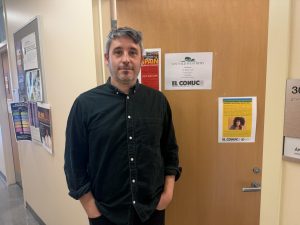
For Lara, Ziali’s story of being born in Morocco and raised in Spain parallels the experiences of many Old Westbury students who come from Latin American backgrounds but were born or raised in the United States.
“Somehow they are like Karima, border people from the cultural and identity perspective,” Lara said.
That shared inbetween experience, he believes, will make the conversation especially meaningful for students.
Lara also connects Ziali’s work to his own teaching on Spanish history and culture, particularly the often overlooked coexistence of Muslim, Jewish and Christian communities in medieval Spain. By highlighting Muslim and Arabic influences that are sometimes hidden in official narratives, he sees Ziali’s perspective as expanding students’ understanding of Spanish identity.
Beyond its cultural themes, the March 30 conversation will also center on the craft of storytelling. Many attendees are literature students, and Lara hopes Ziali’s visit will serve as both inspiration and provocation.
“All events at El Conuco are kind of provocations,” he said. “And bringing an acclaimed novelist to campus encourages students not to abandon books in an increasingly digital world but to think of literature as something so important.”
For Ziali, the ultimate goal of her talk is to challenge the idea that migration stories belong only to “others.”
“This is not an issue that belongs to the others,” she said. “It’s an issue that belongs to the whole society. If society treats migration as someone else’s problem, it risks becoming a sick society, disconnected from a vital part of itself.”
By sharing her work, Ziali hopes to send a clear message, “We exist, and our experiences matter.”
A Liminal Storytelling: A Conversation with Writer and Scholar Karima Ziali. Mon., Mar. 30 at 11:40 a.m., NAB 3101 at SUNY Old Westbury.