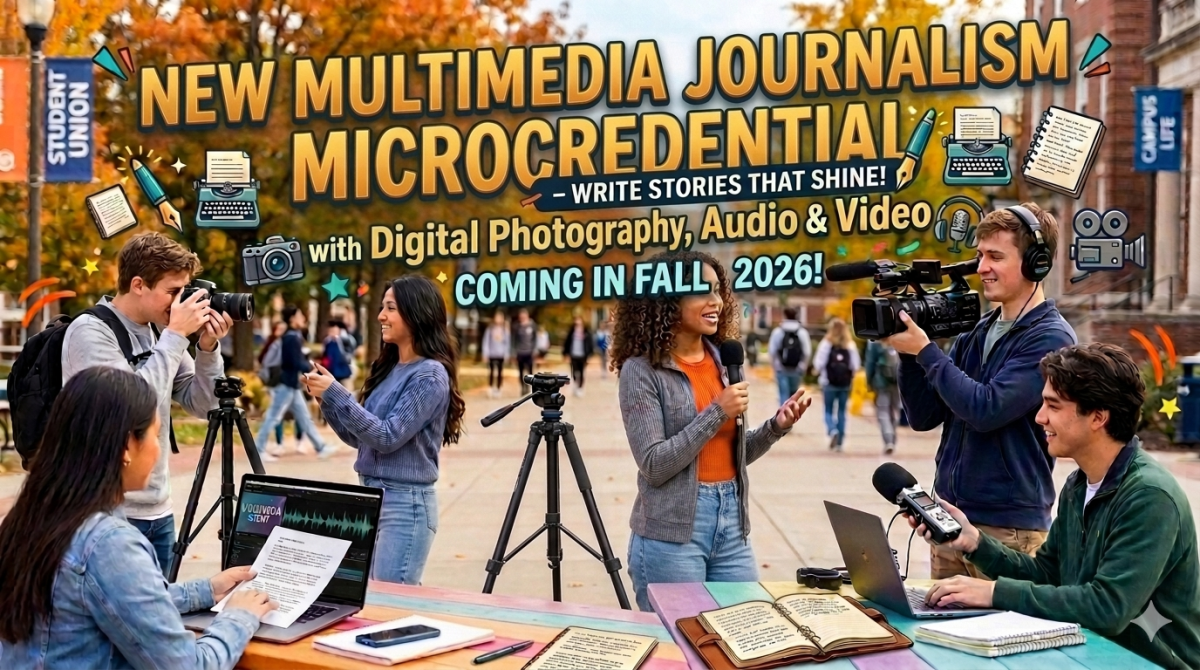











SUNY Old Westbury is introducing something new, exciting, and actually useful for students looking to stand out after graduation – a journalism microcredential that focuses on real-world skills, creativity and collaboration.
According to Wendy Rhodes, an assistant professor in the media and communications department and the faculty advisor to the student news site, The Catalyst, the idea behind the new microcredential is simple: help students become more competitive in today’s job market.
“The job market is wicked competitive,” Rhodes said. “When students leave here, they’re competing against people with strong credentials. We want to make sure our students are as prepared as possible.”

While a degree in media and communications is valuable on its own, Rhodes explained that adding a microcredential shows employers something extra. It highlights specialized skills and deeper knowledge in areas like multimedia journalism, giving students an advantage when applying for jobs.
“The goal is really to make students better at their craft and more marketable when they graduate,” Rhodes said.
The program focuses on giving students hands-on experience that reflects what it is actually like to work in the media industry.
“This is going to be the closest thing to what you would experience if you were actually out working in a digital news environment,” Rhodes said.
A major part of the microcredential is learning how to tell a story.
“Students have to know the art of storytelling,” Rhodes said. “How to know when something is timely and newsworthy and make it into an engaging story that people will interact with.”
Whether it is written, visual, or audio, Rhodes emphasized, storytelling is at the center of everything. Students will also learn how to adhere to Associated Press style – better known as AP Style – writing, which is a critical skill in journalism.
“You have to have that skill when you leave here,” Rhodes said. “Most digital news sites in the country, if not the world, use it.”
The program includes three main courses. The first introduces students to the fundamentals of journalism, including how to identify strong stories and write in AP style.
The second allows students to begin producing content for The Catalyst.
“You’re actually getting news clips that you can use when you apply for jobs,” Rhodes said. “They’re not really looking for a paper you wrote for a class – they want to see something published.”
The final course, Digital News Lab, simulates a real newsroom, giving students a full professional experience before they graduate.
Rhodes also stressed that the microcredential isn’t just for journalism majors.
“These are skills that are transferable to anything,” she said. “It doesn’t matter what your major is.”
She added that storytelling is valuable across fields, from law to science, because it helps people communicate complex ideas clearly.
Beyond career benefits, Rhodes hopes students enjoy the experience.
“The goal is not only to learn, but to have fun and collaborate,” Rhodes said. “You might as well have fun while you’re here.”