















SUNY Old Westbury’s Spring 2026 programming continues with a special screening on March 2 of “In the Summers” followed on March 4 by a question and answer session with film director Alessandra Lacorazza. The award-winning film is an intimate portrait of family, memory and identity.
The film, which won the U.S. Dramatic Grand Jury prize at the Sundance Film Festival, follows two sisters navigating their evolving relationship with their father through a series of summer visits over the years. Told in fragments, the story captures how memory, distance and emotional growth reshape how children come to understand their parents the older they get.
For Lacorazza, the story began with a desire to see more honest representation on the screen.
“I think, growing up in the United States, I wanted a more varied representation of Latins and queers,” Lacorazza said. “I wanted something that was a little bit more true to my life.”
Rather than framing the father as simply good or bad, the film leans into emotional complexity.
“I had a very complicated relationship with my father, but he is one of the most beautiful human beings I ever met,” Lacorazza said. “I wanted to be able to show that side of Latin fatherhood — something that was complex and beautiful, but also did not shy away from the hard parts.”
The film’s structure – moving through summers instead of a continuous timeline – was one of the first ideas she developed.
“After my dad had died, my sister and I were just around a dinner table going through a timeline of our lives with our father,” Lacorazza said. “It ended up being in these fragments through time because we didn’t really talk to him outside of the summers we spent with him.”
That fragmentation, she explained, became a way of building a portrait of someone through emotional shifts felt years apart.
The desert setting also carries symbolic meaning. Though Lacorazza did not grow up in Las Cruces, the landscape blends elements from different parts of her upbringing.
“I see them as these prickly flowers that grow in barren land,” Lacorazza said. “I thought that was an apt metaphor for them.”
The wide, open desert becomes more than just a backdrop. It mirrors the emotional isolation between the characters while also highlighting their resilience – showing how growth can happen even in difficult environments.
The film has received national attention not only for its storytelling but also for its creative choices, including the decision in its original release not to subtitle certain Spanish dialogues – a choice that has sparked discussion among audiences.
“That always provides an interesting conversation around my decisions for that,” Lacorazza said.
By leaving portions untranslated, the film challenges the viewers to sit with the moments of uncertainty and linguistic distance. This shows an experience that reflects how language and belonging shape identity within immigrant and bilingual families.
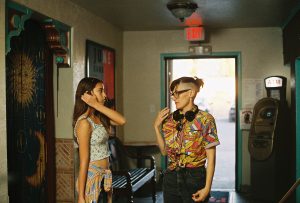
For students attending the March 2 screening, the conversation will not end with just the credit rolls. Lacorazza will return for a live question and answer session on Wednesday, March 4, giving students the opportunity to ask questions about the film’s structure, symbolism and personal inspiration.
“I love Q&As and I love talking to people about the film,” Lacorazza said. “I find college students to be really good watchers of films and always come with really interesting questions and perspectives.”
As students leave the room, Lacorazza hopes one idea lingers.
“The complexity of our relationships with our parents and how hard that is,” she said. “It’s an ever-evolving process that, at every stage of your life, you’re going to be reflecting on.”
For Lacorazza, the film is less about answers and more about understanding.
“When someone dies, your relationship with them sort of continues, but it becomes one-sided,” she said. “There was a lot to understand about his version of events that happened after he died.”
“In the Summers” film screening. Mon., March 2 at 2:40 p.m. at the Duane L. Jones Recital Hall in NAB211. Free and open to all students.
Question and answer with “In the Summers” director Alessandra Lacorazza. Wed., March 4 at 2:40 p.m. Duane L. Jones Recital Hall in in NAB2111. Free and open to all students.