







Flamenco will take center stage at SUNY Old Westbury on April 2 as Spanish dancer and multidisciplinary artist Cristina Candela brings rhythm, history and movement to campus for an immersive workshop designed to introduce students to the heart of the art form.
The event, presented through El Conuco as part of its annual spring flamenco programming, will blend cultural context with hands on dance instruction. Candela, now based in New York City after building her career between multiple cities, said the session is designed for everyone, even those who have never encountered flamenco before.
“Since I don’t really know if there’s someone who knows anything about flamenco, I will try to put a very short explanation so we give some context,” Candela said.
The workshop will begin with rhythm exercises, including clapping patterns central to flamenco’s structure, before transitioning into movement.
“We will learn something,” she said. “The goal of the class is that we end up able to clap and to dance to a flamenco lyric in fiesta, party style.”
By the end of the session, participants won’t just be watching flamenco, they’ll be part of it.
“The goal is that you can join a flamenco party, knowing what it is about,” Candela said.
For Candela, who describes herself as both a traditional flamenco dancer and a multidisciplinary artist, teaching beginners is both a challenge and a joy.
“It’s very beautiful when I arrive to a place where all my students know nothing about flamenco,” she said. “My challenge is first to make them curious about it. Then to see them dancing and enjoying.”
Her extensive training and work with diverse groups, from musicians to dancers to students simply curious about the art form, has shaped a flexible teaching style.
“With experience, you’re quicker reading the room,” Candela said. “Some groups gravitate toward rhythm, others toward body technique. And sometimes you end up in a flamenco party with people that didn’t know about flamenco an hour ago.”
That spontaneous, communal spirit reflects flamenco’s roots. Though its influences stretch back centuries, flamenco as a formalized art emerged in the mid-19th century. It grew from marginalized communities before eventually moving onto major stages and gaining global recognition. Today, it is recognized by UNESCO as Intangible Cultural Heritage of Humanity, a testament to its depth and cultural importance.
Candela emphasized that flamenco’s history makes it especially meaningful in contemporary society. Born from communities “not wanted by society,” she said, the art form ultimately “stole the heart of a lot of people.”
In a time when cultural differences can feel divisive, she sees flamenco as a powerful reminder of how expression from the margins can shape the mainstream.
Improvisation is also central to her approach. Flamenco, she explained, functions like a shared language developed over time.
“When you hang out with your friends and you sing or dance, you don’t prepare choreography beforehand, you just go there and have fun,” she said. “If you do that regularly, you end up creating a language.”
Her workshop offers what she calls “a first visit to the flamenco language,” starting with rhythm, then song, then dance layered on top.
Angel Lara, director of El Conuco and associate professor of sociology at SUNY Old Westbury, said bringing artists like Candela to campus helps challenge misconceptions about flamenco as merely a tourist spectacle.
“By bringing real flamenco artists to campus, we are showing a deeper understanding of that particular culture,” Lara said.
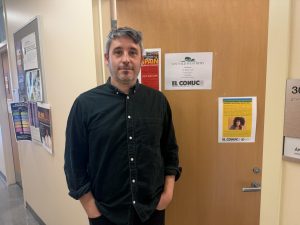
For Lara, flamenco represents more than music or dance. It is a living, evolving cultural expression.
“Flamenco is like a living animal,” he said. “It’s not an object that belongs to the past. It’s involved in a continuous process of innovation and change, and Candela’s blend of traditional technique with contemporary and narrative elements demonstrates that evolution.”
Beyond cultural education, Lara hopes the workshop expands students sense of what academic life can include.
“Dancing has to do with the body,” he said. “It’s different from the usual things that we do here in college.”
He believes events like this broaden learning beyond lectures and exams, integrating performance and embodied knowledge into campus life.
As a sociologist, Lara also sees performing arts as essential to understanding cultural memory and identity. Through flamenco, students can explore the historical experiences of marginalized communities in Spain and across the Hispanic world.
“Performing arts have to do with expression, cultural expression,” he said. “Bringing artists from Spain, Latin America and Latino communities in the U.S. contributes to what he describes as one of SUNY Old Westbury’s defining qualities, diversity.”
For students interested in dance or performance, Candela offered simple but profound advice to remain open.
“You have to be really tender and careful with yourself,” she said. “If you allow yourself to be you, you will find your voice, and you will enjoy much more your artistry.”
Come step into the rhythm, learn the language, and discover how flamenco transforms from history into lived experience, one clap at a time.
Flamenco Workshop with Cristina Candela. Thurs. Apr. 2 at 1:30 p.m., Duane L Jones Recital Hall at SUNY Old Westbury.