



































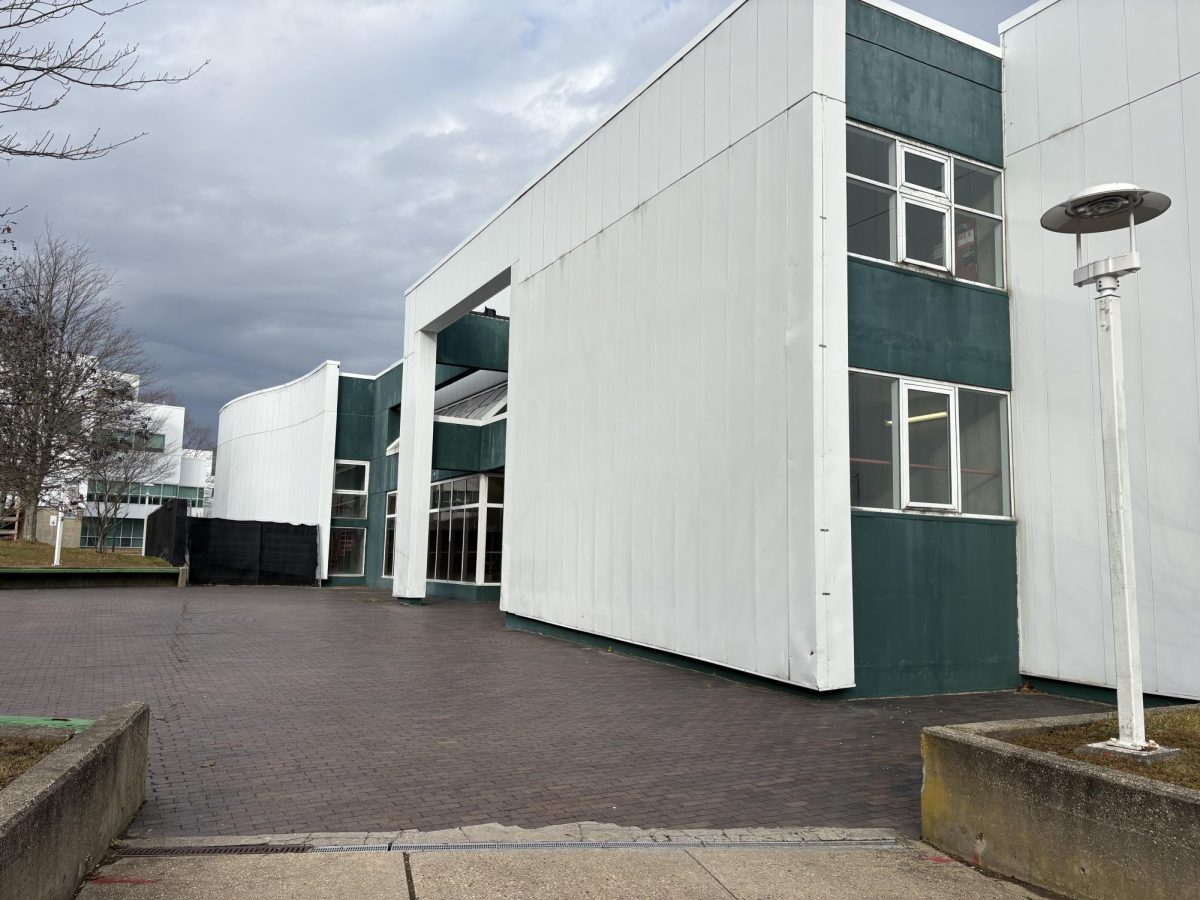
In a milestone moment for SUNY Old Westbury, the Natural Sciences building is currently receiving a major upgrade of its facilities. The upgrade is expected to be 50% more energy efficient and will boast a geothermal system for heating and cooling, as well as energy efficient glazing on the facility’s windows.
SUNY Officials broke ground this past February on the $200 million project, and it will be the first major update to the building since it was built in 1985.
The project will be completed in three phases. Phase one will include installation of geothermal wells, providing energy-efficient heating and cooling; phase two will consist of an addition to the existing building; and phase three will be the renovation of the interior of the building.
“We will be fully electric,” said Ray Maggiore, the university’s assistant vice president for capital planning. “Instead of using gas to send heat to our air handlers, we’ll be getting that from the earth.”

This project is expected to exceed the school’s energy and carbon reduction goals by approximately 9%, and this will help assist in the goal of 100% zero emission electricity by 2040 and 85% reduction of greenhouse gas emissions by 2050. And it doesn’t end there.
According to the school website, the final phase will include a green roof. A green roof provides a multitude of benefits, such as a building with better thermal performance, reducing the both level of temperature regulating required and improving the efficiency at which they run through reduced leakage.
“For heating and cooling the building they’re using geothermal energy and they’re using a vertical model which means they’re going down and drilling boreholes,” said Prof. Timothy Strout, who specializes in environmental science. “It’s a closed loop system so that everything’s kept within. They won’t be affecting groundwater. So we won’t have to burn fossil fuels or anything like this for energy. It’s essentially a win-win.”
Strout emphasized how much of a victory this is for the university and the environment around it.
“It will be much better for the environment while also being cost efficient,” said Strout. “It’s an old building and our programs are advancing, and if we’re gonna keep a competitive STEM program, we need to have a more updated facility. We could use the space and more labs, and this will help the school into the future.”
A closed-loop geothermal system will be powering the new building, and this should dramatically cut energy use. By relying on this system to power the new building instead of fossil fuels, it will be better for the environment.
Prof. Fernando Nieto of the science department at Old Westbury stressed how key it is that we will be using clean energy.
“It’s part of the efforts of the state of New York to kind of free ourselves of fossil fuels,” said Nieto. “In the context of ameliorating climate change or slowing it down. So, new construction and in particular this construction of the new science building will leave no carbon footprint – it will rely mainly on geothermal energy which will be clean energy, saving money and the environment at the same time.”
The new system represents one of the most ambitious sustainability upgrades for campus to date. With the building expected to serve as a centerpiece for STEM programs, administrators hope this will serve as a real life example of modern clean energy technology for everyone in the community.